






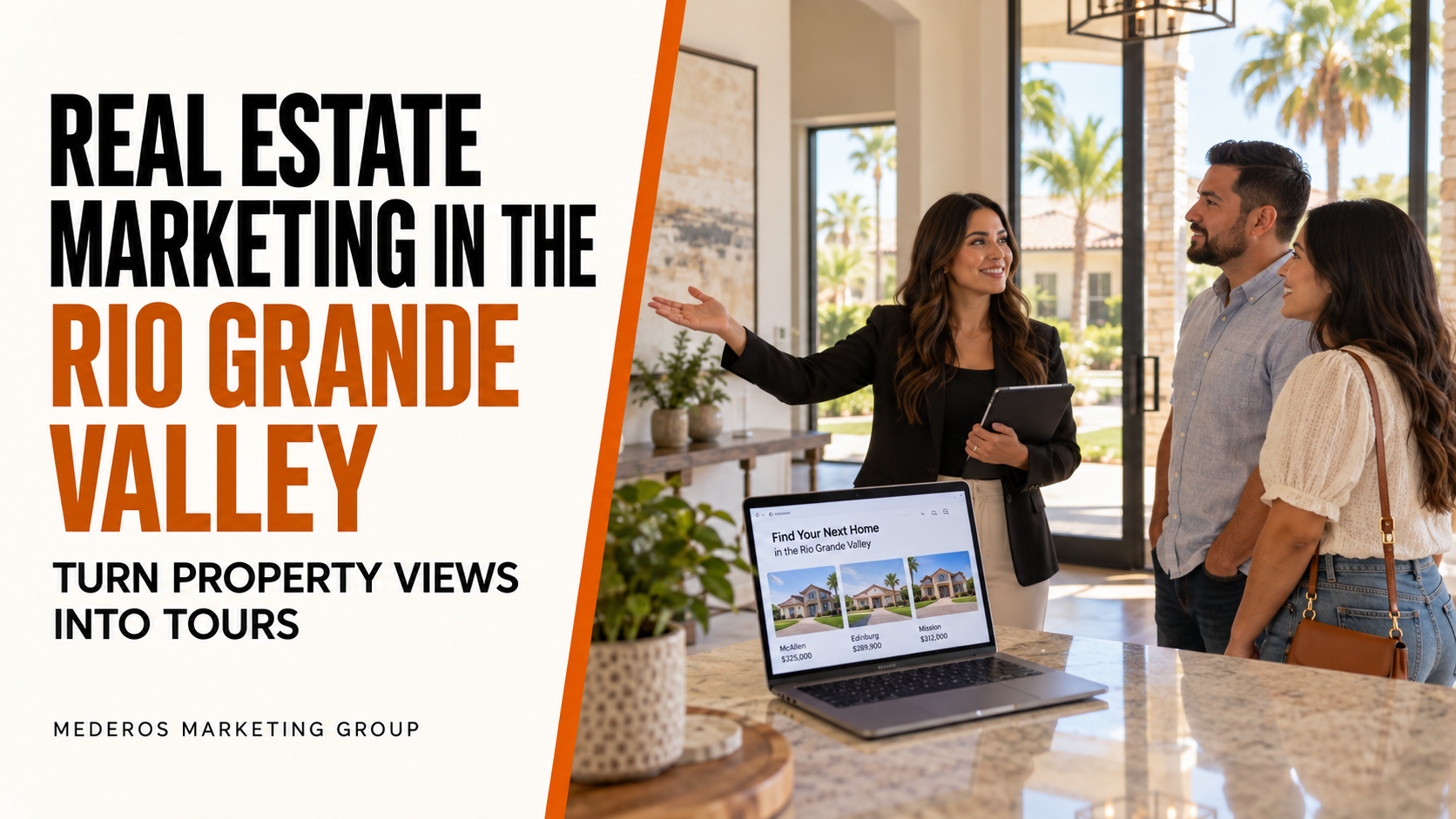

A property video can collect views while the tour calendar stays empty. A listing can generate inquiries that never become conversations. Before increasing your advertising budget, look at what happens between the first impression and the appointment.
Real estate marketing in the Rio Grande Valley needs to connect accurate property information, useful visuals, advertising, and a reliable response process.
For an apartment community in Edinburg, the immediate goal might be scheduled leasing tours. For a real estate agent promoting a home in Mission, it might be showing requests. Define that goal first, then build the marketing around it.
Start with the property and the next step
Choose the property, floor plan, or available inventory you need to promote. Identify what a prospective buyer or renter needs to understand before contacting you.
For an apartment campaign, that could include current availability, rent, floor plans, lease options, relevant fees, pet policies, and the tour process. For a home listing, it could include the asking price, property features, location, condition, and showing arrangements.
Check every promotion against the current offer. If an advertised starting price applies only to certain units or lease terms, explain that clearly.
Then choose one primary action. “Schedule a Tour” communicates a different next step from “Request Available Floor Plans.” Use the action that matches what your team can deliver.
Use photography and video to explain the space
Create a visual sequence that helps someone understand how the property fits together.
For a walkthrough, begin at the entrance and move through the main living areas, kitchen, bedrooms, and relevant outdoor spaces. Show connections between rooms so viewers can follow the layout.
Include images of practical details such as storage, laundry facilities, parking, and common areas when they are part of the offering.
For a community with several floor plans, label the model shown. If the video features a staged apartment, explain that context. Clearly identify renderings and proposed features so viewers understand what exists today.
Build several useful assets from the same shoot:
- A complete walkthrough for the property page.
- A short video introducing one floor plan.
- Individual feature clips for social media.
- A consistent photo collection for listings and ads.
Aim to answer the questions people would otherwise need to ask before agreeing to a tour.
Give each campaign a relevant property page
Someone who clicks an advertisement for a specific apartment should arrive at information about that apartment or floor plan.
A campaign page should make the property name, location, current offer, and next step easy to find. Include the visuals and details needed to decide whether to inquire.
Keep the initial form focused. A name, preferred contact method, property interest, and desired tour timing may be enough to start a conversation. Collect sensitive application information later through the appropriate application process.
Test the page on a phone. Submit the form, follow the confirmation, and check that the inquiry reaches the right person. If you offer online scheduling, confirm that the available times reflect your team’s actual calendar.
This is also the place to explain whether someone is booking a confirmed appointment or requesting a time that still needs approval.
Make local content useful to someone comparing locations
Local SEO content should answer questions about the property and its surroundings.
An Edinburg apartment page might explain the property’s location relative to a named UTRGV campus, using verified information. A Brownsville listing could provide clear directions and describe nearby amenities that are relevant to the property.
Be precise about locations and distances. If you include estimated drive times, identify them as estimates and explain that traffic can change them.
Build content from recurring questions: where visitors should park, how to find the leasing office, what a tour includes, or which utilities are included in a particular offering.
When publishing city pages, give each one useful, distinct information. Google’s spam policies identify substantially similar pages created to funnel city searches to the same destination as a form of doorway abuse.
A page should help someone evaluate a real option in that location.
Match advertising to the property campaign
Google Search ads can reach people actively searching for relevant services or offerings. For a leasing campaign, an example search theme might be “apartments in Edinburg.” Treat that as a starting point to research, then review actual search activity and inquiry quality.
On Facebook and Instagram, test property walkthroughs, floor plan introductions, and clear explanations of current availability. Make sure the advertisement and destination page show the same offer.
Housing advertising also has specific platform requirements. Google’s U.S. housing policy restricts targeting by age, gender, parental status, marital status, and ZIP code. Review the applicable housing requirements in each platform when setting up the campaign.
Use accurate property features and location information to communicate the offer. Keep advertisements updated when inventory, pricing, or incentives change.
Give every inquiry an owner
Assign responsibility for new inquiries before launching a campaign.
A useful first response should reference the property the person asked about, answer their question, and provide a clear next step. If they asked whether a floor plan is available, address availability before sending a general brochure.
For tour requests, confirm the date, time, address, parking instructions, and contact person. Make rescheduling straightforward.
If someone contacts you outside business hours, explain when they can expect a response. Set a response standard your team can maintain, then check whether it is being met.
With multiple communities, route each inquiry to the correct leasing team. Track missed calls and unanswered forms so they can be followed up.
Measure the path to an attended tour
Keep a record of what happens after each inquiry.
For apartment marketing, useful stages include a new inquiry, a conversation, a booked tour, an attended tour, an application, and a signed lease. For home sales, use the equivalent stages relevant to your process.
The points where people stop responding can help you decide what to investigate:
| What you see | What to check |
|---|---|
| Clicks with few inquiries | Property information, offer clarity, page usability, and form function |
| Inquiries with few conversations | Contact details, response timing, and routing |
| Conversations with few bookings | Availability, pricing clarity, unanswered questions, and scheduling |
| Bookings with low attendance | Confirmations, directions, reminders, and rescheduling options |
These patterns are starting points for investigation. A drop at one stage can have several causes.
Review cost per attended tour alongside cost per inquiry. A less expensive lead is only useful if it contributes to the result the campaign needs.
Build a clearer real estate marketing process with MMG
Mederos Marketing Group supports real estate businesses across the Rio Grande Valley with property photography and video, website and landing page design, content creation, and advertising management.
We help connect the way a property is presented with the steps prospective buyers and renters take to inquire.
Book a free 30-minute marketing strategy session to discuss your properties, current marketing, and tour goals.